Websites | What’s Alan Watching – great place for thought provoking & insightful TV commentary

FacebookTwitterGoogle+PinterestLinkedInRedditDiggShare

When I want to know what’s worth watching, I always go to “What’s Alan Watching”. And whenever I’m confused by something I’ve already seen, my TV pal can always be counted on to fine tune my mind’s screen.
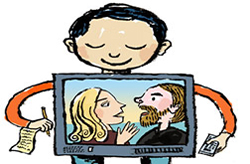
Alan Sepinwall tv commentary siteAll through his childhood, Alan Sepinwall’s relatives told his parents, “All that boy does is watch television! How’s he going to make a living doing that?”

His career as a TV critic has been 15 years and counting of his attempt to answer their concerns. “What’s Alan Watching” is a blog whose title is self-explanatory: Alan watches TV shows, then writes about what he watched.   

Here’s an excellent article about Sepinwall from Slate.com’s editor, Josh Levin.

Alan Sepinwall changed the nature of television criticism. But can you be both a rabid fan and a thoughtful reviewer?
By Josh Levin

Alan Sepinwall started writing about television in 1993, as a sophomore at the University of Pennsylvania. He stank at it. In 2004, Sepinwall characterized his early work thusly: “Misspellings, bad grammar and, even worse, observations that make me cringe and wonder exactly when (or if) I stopped being such a dumbass.” Alan Sepinwall - headshotHe soon outgrew his dumbass ways. By the end of his undergrad years, Sepinwall had parlayed his role as the leading NYPD Blue fanboy of the newsgroup era into a gig as the Newark Star-Ledger’s TV critic. “[W]ithout Blue,” he wrote in 2004, “I wouldn’t have the career or the life that I currently do.”

Television, and television writing, have transformed since Dennis Franz’s bare butt launched Sepinwall’s career. Upon NYPD Blue’s early ’90s debut, it was heralded as one of the best shows ever made. In comparison with The Sopranos, The Wire, and even Lost, David Milch and Steven Bochco’s cops-and-perps procedural now looks prehistoric.

Today’s more ambitious shows demand more ambitious commentary. In 2002, Sepinwall wrote his first post-episode Sopranos breakdown. This was a new form, a hybrid of the inside-joke-laden episode recaps pioneered by Dawson’s Wrap (which later expanded under the name Mighty Big TV, then was re-renamed Television Without Pity) and the NYPD Blue disquisitions from Sepinwall’s dorm-room days. If you wanted to understand the subtext and symbolism of HBO’s epic mob series—the long-ago motivation for one of Tony’s murders, the meaning of an end-of-episode quacking sound—you had to read Sepinwall’s sprawling write-ups.

Alan Sepinwall - illustrationAfter 14 years at the Star-Ledger, Sepinwall left the paper in 2010 to blog for HitFix.com. The style of TV criticism he helped invent is now ascendant. Gawker, New York’s Vulture, and the Onion’s A.V. Club employ teams of recappers to parse the previous night’s dramas, sitcoms, and reality fare. Slate supplements Troy Patterson’s criticism with weekly dialogues on shows like Lost, Mad Men, and Friday Night Lights. Sepinwall, though, is the acknowledged king of the form.

As the A.V. Club’s Steve Heisler explained last year, “he’s an inspiration to TV critics throughout the country. His recaps appear online in record time, typically bursting with incisive commentary and wit.” Sepinwall’s output is also legendary: He’s currently reviewing between 10 and 15 shows each week, which he says is “a fairly light schedule for me.” (Advance screeners help on that score.)

Sepinwall-style criticism has obvious strengths. Week-to-week coverage reflects how people actually watch their favorite shows—we rehash the best lines, parse the meaning of weighty moments, and anticipate plot twists. At its best, new-school TV writing is brainy and inquisitive, thoughtful commentary borne out of a fanatical attention to detail. But hypervigilant criticism, written by obsessive fans for obsessive fans, isn’t necessarily an unmitigated force for good. Is it possible that today’s TV writers are sitting too close to the screen?

Alan Sepinwall - tv show reviewerTelevision criticism used to be like restaurant criticism: A writer would sample a few episodes and then issue an informed recommendation. Today, it’s more akin to visiting the same restaurant every week, then reporting back on the mood of the wait staff, the condition of the silverware, and what dishes might appear on the new fall menu.

In a fantastic A.V. Club dialogue about the state of TV criticism, Noel Murray argues that since weekly critics “aren’t primarily engaged in telling people whether they should or shouldn’t watch a show … we get to kick around symbolism, character development, and real-world connections to what’s on the screen.” Rather than tell you what to watch, Sepinwall, Murray, and Time’s James Poniewozik, among many others, validate your interest in the shows you’re already watching. (more)